Official Flight & Reentry Manual
Hypersonic Survival Guidelines for Spacecraft Commanders
1. What is the Game? (Pure Survival, No Magic Flight Sticks)
Entry Vector is not your typical space dogfighter where you yank a joystick, cruise effortlessly through empty vacuum, dodge asteroids, and shoot lasers. Here, your fiercest, most unyielding adversary is classical physics.
It is an atmospheric reentry arcade simulator engineered with a singular focus: challenging your survival management during the most brutal and terrifying minutes of any aerospace voyage.
Your objective is not to execute a picturesque red-carpet touchdown on a runaway. Your victory consists of surviving the hypersonic inferno and crossing the safe altitude line at 5,000 meters with your craft structurally intact (or intact enough for you to walk away).
You will be pushed to make split-second decisions under crushing pressure, decoding real-time telemetry while incandescent plasma roars outside your hull at thousands of degrees Celsius.
2. The Art of Flying: RCS and Propulsion (Thrust)
Forget continuous throttles. During reentry, planetary gravity and your massive initial orbital speed do almost all the heavy (and destructive) lifting.
RCS (Reaction Control System) — Your Lifeline:
Your continuous primary survival tool is the RCS. Using directional keys (Left / Right or A / D), you fire small, pressurized cold-gas pulses to dictate the craft's rotation and attitude.
By tilting your vehicle — adjusting your Angle of Attack (AoA) —, you fundamentally change how hypersonic airflow strikes the heat shield. Pitching up allows you to 'surf' the upper atmosphere to generate lift and bleed speed smoothly, while pitching down slices through with minimal resistance. The master rule is to anticipate movements before dense air snatches aerodynamic control away from your thrusters!
What About Main Engines (Thrust)?
The main engine isn't there for casual cruising: it is strictly an emergency reserve to boost speed in dire situations, violently deflect your flight vector, or provide an emergency lift surge when your descent angle is dangerously steep. It is that 'extra nudge' you shouldn't need on a flawless profile, but one that will save your skin when disaster strikes.
The Ultimate Challenge (Pure RCS Flight):
Depending on the vehicle and entry corridor, it is entirely feasible to survive a mission without ever touching the main engine, commanding solely with RCS bursts and atmospheric aerodynamics! Surviving purely on RCS is the gold badge of veteran commanders. Beware, however: vehicles shaped like 'flying shoeboxes' have minimal lift; for them, RCS alone may fall short, leaving the main engine as your only ticket home.
3. Understanding the Physics (The Mathematical Model)
To master reentry, you cannot rely on guesswork. The simulation computes a consistent aerodynamic and thermodynamic model governed by these core equations:
Exponential Atmospheric Density
ρ = ρ₀ · e^(-h / H)Air is not uniform. Atmospheric density (ρ) increases exponentially as altitude (h) drops, governed by scale height (H). Above 60km, air is near-vacuum; below 30km, it thickens into an unforgiving solid wall.
Aerodynamic Drag & G-Load
F_drag = 0.5 · ρ · v² · C_d · AThe brute braking force resisting vehicle forward motion. Note the v² factor: doubling your velocity quadruples drag! Drag is directly responsible for the bone-crushing G-forces threatening to collapse your airframe and incapacitate the crew.
Aerodynamic Lift
F_lift = 0.5 · ρ · v² · C_l · ABy pitching the heat shield relative to incoming airflow (AoA), the vehicle deflects air downwards, generating upward perpendicular force. Lift lets you loft and glide in the thinner atmosphere, shedding kinetic energy before plunging into the fiery furnace.
Hypersonic Heating & Gradual Degradation
Q_flux ∝ ρ^0.5 · v³ | T_crit = 2,000 °CExtreme heat does not stem from simple skin friction, but from the violent compression of the shockwave ahead of the shield. There is a nominal envelope (up to ~1,500°C) and a critical structural threshold (2,000°C).
Crucial Mechanic: Destruction is never instantaneous! Once critical temperature is breached, the vehicle begins to degrade gradually, losing shield health tick by tick. This gives you precious seconds to adjust attitude, bleed heat flux, and pull off a miraculous recovery!
4. Vehicle Configurations: Lift Capacity & Thermal Mass
Aerodynamic Lift Capacity
Different vehicle geometries produce vastly different behaviors. Classic blunt capsules (like Apollo or Orion) generate modest lift and follow predominantly ballistic trajectories. Winged orbiters or lifting bodies (like the Space Shuttle) produce abundant lift, allowing extended hypersonic glides and controlled atmospheric skip maneuvers.
Thermal Mass & Shield Inertia
Thermal mass dictates how quickly the shield absorbs thermal energy. A dense, thick heat shield possesses high thermal inertia: it takes far longer to reach hazardous temperatures, forgiving steeper and more aggressive descent dives. Conversely, lightweight vehicles or minimal shields heat up in seconds, requiring surgical speed dissipation in high altitudes.
5. Survival Manual: 6 Vital Management Tips
Vaporizing into space dust is a rookie rite of passage. To transform chaotic plunges into textbook recoveries, drill these six golden rules into your routine:
Bleed Energy Early (The High-Speed Trap)
If you are burning up or suffering destructive G-spikes in the mid and lower atmosphere, the diagnosis is clear: you entered the dense layers far too hot! Expose your heat shield at higher altitudes (above 40-50 km), where thin air generates safe braking drag with manageable heat flux. Scrubbing orbital speed up high is the secret to survival.
G-Force Management (Lower the Nose!)
When deceleration violently escalates and the G-Load meter threatens structural failure, do not freeze up: pitch the nose forward (reducing your Angle of Attack). Slicing into the airflow with a sleeker profile instantly cuts drag and drops G-forces within the same second.
Beware of the Atmospheric Skip
Do not get greedy generating lift on shallow entry corridors. If you are blazing fast and pitch up too aggressively, your craft will bounce off atmospheric density like a skipping stone on a pond, catapulting you back into the frozen void and ending your mission in trajectory loss.
Avoid Frenetic Corrections (Pilot-Induced Oscillation / PIO)
In thin upper air, aerodynamic damping is nearly non-existent. Frantically tapping left and right RCS thrusters sets up an escalating pendulum sway. By the time dense air arrives, you will be caught sideways! Make smooth, patient inputs and let the vehicle's natural aerodynamic stability do its job.
Don't Fight the Atmosphere, Surf It
You will never overpower dense atmospheric airflow with brute RCS thrust. If aerodynamic stability wants the craft aligned in a specific groove, fighting against the stream only drains propellant and exposes delicate side structures. Find the trim angle of least resistance that still yields your desired lift or drag.
Master the Free Flight Mode (Your Proving Grounds)
Jump into Free Flight Mode, turn on full telemetry, and experiment with radical attitudes without risking your career stats. Visually tracking heat, dynamic pressure, and drag curves will calibrate your commander instincts. Remember: even in free sandbox tests, the laws of thermodynamics and structural G-limits remain unforgiving!
"Stay calm, keep your eyes glued to temperature readouts, and have a safe reentry!"
6. Onboard Instruments (HUD) and Force Vectors
The Entry Vector HUD is designed for instantaneous situational awareness. Mastering every gauge and reading real-time force vector arrows marks the difference between a historic splashdown and vaporizing into the annals of history.
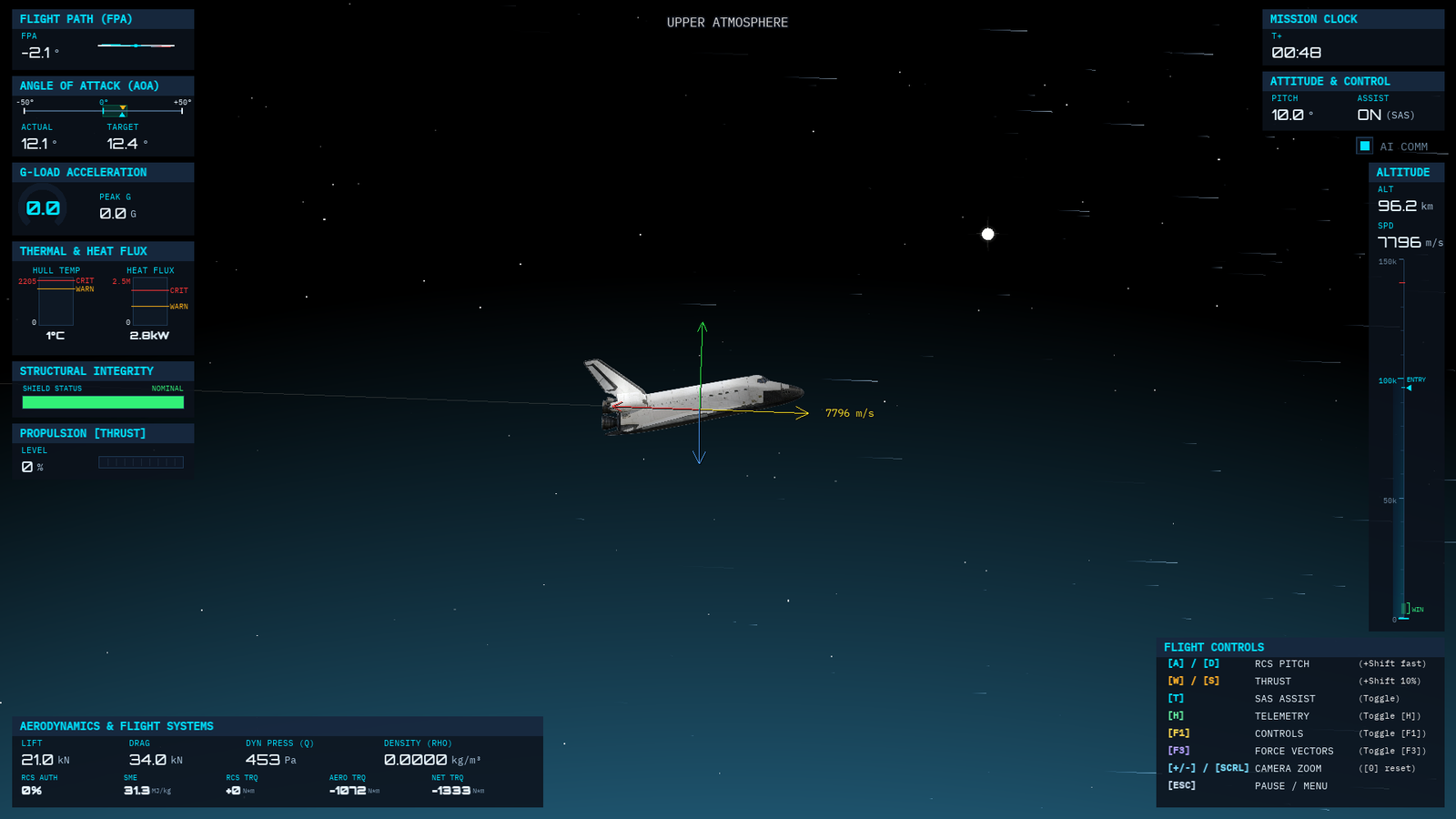 Complete overview of the instrument panel and flight telemetry.
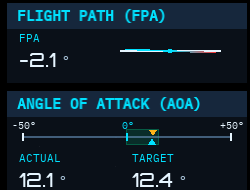
Trajectory & Attitude (FPA & AOA)
- FLIGHT PATH ANGLE (FPA): Shows your velocity vector angle relative to the local planetary horizon. Negative values indicate descent.
- ANGLE OF ATTACK (AOA): Measures the angular difference between capsule nose pointing direction and actual velocity path. Aligning AOA with target is essential to balance lift and drag.

Acceleration & G-Force (G-Load)
- Monitors instantaneous deceleration and cumulative peak load (PEAK G) experienced by structure and crew.
- Overly aggressive descents into thick air cause redline G-spikes that tear the hull apart long before thermal limits are hit.
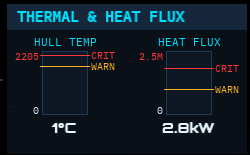
Thermal Management & Heat Flux
- HULL TEMP: Shield and hull skin temperature. Keep an eye on warning (WARN) and critical (CRIT) thresholds. Reaching critical starts continuous progressive degradation.
- HEAT FLUX: Rate of incoming thermal energy per second. High heat flux causes temperatures to skyrocket uncontrollably!

Structural Integrity & Propulsion
- SHIELD STATUS: Health and remaining thickness of the ablative heat shield (Nominal = Safe).
- PROPULSION [THRUST]: Active throttle percentage of the main propulsion system for emergency maneuvers.

Aerodynamics & Flight Dynamics
- LIFT & DRAG: Real-time aerodynamic forces of lift (upward) and drag (braking), measured in kiloNewtons (kN).
- DYN PRESS (Q): Dynamic pressure exerted by oncoming air. At peak Q, control surfaces and RCS thrusters become ultra-sensitive.
- DENSITY (RHO): Local ambient air density (kg/m³).
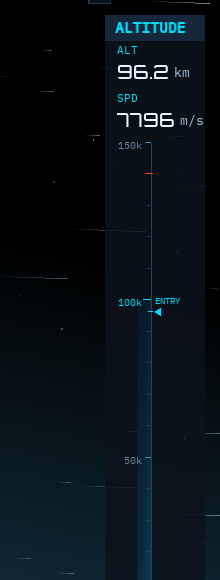
Altitude, Speed & Flight Systems
- ALTITUDE & SPD: Absolute altitude in kilometers and true airspeed in m/s. Your target is reaching 5 km intact.
- ATTITUDE & SAS: Confirms active pitch angle and Stability Augmentation System (SAS) status, dampening violent oscillations.
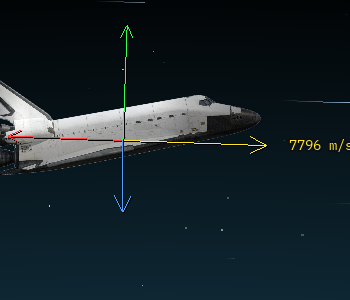
Real-Time Force Vectors (Press F3)
Pressing F3 toggles real-time physical force vectors acting directly upon the vehicle's center of mass:
- Yellow Arrow (Velocity): Indicates the exact vector and direction the spacecraft is moving through space, regardless of where the nose points.
- Red Arrow (Drag): Points directly opposite to velocity. This is atmospheric air slamming the brakes. The larger this arrow, the higher your heating and G-load.
- Green Arrow (Lift): Aerodynamic force perpendicular to flight path generated by AoA air deflection. Points up to loft the vehicle; points down to drag it downward.
- Blue Arrow (Gravity): Constant planetary gravitational pull directed toward the planet's core.
Golden Vector Rule: When the green arrow (Lift) points upward, you are 'surfing' the upper atmosphere. If you pitch down and the green arrow vanishes or flips, your craft plunges like a stone, making the red drag arrow violently spike!